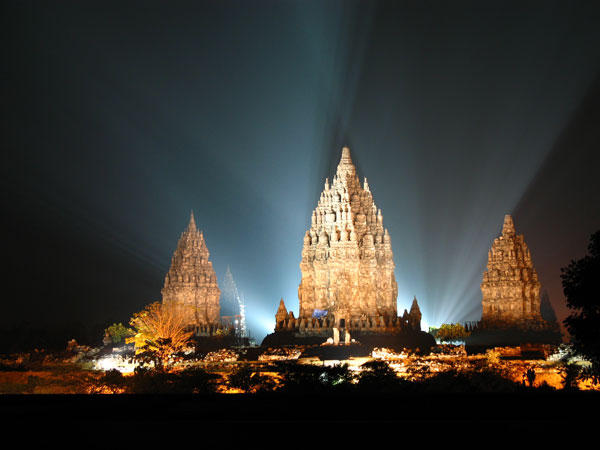
 Located 16 km to the east of the city of Yogyakarta or on the north side of the road Yogya-Solo precisely located in the village of Karangasem district Bokoharjo Yogyakarta Sleman district, administratively Prambanan temple is located on the border between the district of Klaten (Central Java) and the district of Sleman ( Yogyakarta).Prambanan is the largest Hindu temple in Central Java with a height of about 47 m, but as with the other temples, Prambanan temple was rediscovered in a state of collapse and destroyed and overgrown with shrubs. This is because man has abandoned his supporters hundreds of years ago. Administratively, this temple complex located on the border of Central Java and Yogyakarta. Community often refer to this temple to temple Larajonggrang name, a label which is actually a misnomer because it should Rara Jonggrang. Rara said in the Java language to refer to girls. In the folklore known as Rara Jonggrang Ratubaka Prabhu daughter whose name is immortalized as the name of the heritage building complex in the hills south of Candi Prambanan Saragedug.Narrated in the story there is a giant Bandung Bandawasa name.He has a supernatural strength and wanted to marry the daughter of Rara Jonggrang. For that he must make a thousand temples with statues in it overnight. Demand is met by the Bandung Bandawasa, but Rara Jonggrang cheating so that when the temple was unfinished is determined, is less a statue again. Bandung Bandawasa angry and cursed princess Rara Jonggrang complement the thousandth statue. Statues are believed to be the statue Durgamahisasuramardhini in the north of Shiva temple chamber. What is clear Durgamahisasuramardhini is the wife of Lord Shiva. Picture of the cluster of temples such as those mentioned in the inscription Ciwagrha can be compared with the temple complex of Prambanan, indeed cluster of temples built fenced wall around its center and surrounded by a row of ancillary compiled cnadi bersap only Prambanan. Similarly, mention all the ancillary temples similar in shape and size. Another interesting point is also enclose two temples, each one near the entrance to the north and south.Description of the cluster of temples located near the river is reminiscent of the cluster with the river Opak Prambanan temple in the west and if the distance between the river and galaxies Opak Prambanan and the deflection of the deflection of the flow of the river probably occurred between the villages and Bogem Kelurak.Thus, it seems that the description contained in the inscription on the cluster of temples Ciwagrha is more suited to the circumstances of Prambanan temple. Religious nature of the Hinduistis Prambanan temple, among others, can be known of the arrangement pantheon or statues and reliefs dipahatkannya story. Four of the six main temples and ancillary existing first page inside the cubicle, cubicle there is a statue. Shiva temple has four chambers, namely the main east-facing room with a statue of Shiva Mahadeva who stands above the yoni supported by seekornaga. Mahadeva Shiva statue is central to worship in the temple of Prambanan. A second chamber in the south of the Grand Master with a statue of Shiva; west side of the third chamber contains a statue Ganeca (son of Lord Shiva) which is described bekepala elephant-bodied man. The fourth room contains a statue of the north side of the statue of Durga durga Mahisasuramardhini (cakti / Shiva's wife) who managed to defeat the giants in the form mahisa (bull). Arca is depicted standing on the back of the bull with his hand pulled oxtail. This statue is known in folklore as the statue Rarajonggrang, daughter Boko9 Prabhu. The layout of the statues were not uncommon at temples in India. There are some experts argue that the ordinance of the gods in the temple Siwatersebut represents the structure of the government. Lord Shiva as the main deity of the ruling described the king. Lord Shiva represents the Grand Master of the priest who became a spiritual adviser to the king. Ganeca god as the god of war symbolizes the defense forces, was god king's consort Durga Mahisasuramardhini illustrates that always accompany the king. In the Vishnu temple there is only one bilikdan with a statue of the god Vishnu, while the Brahma temple chamber with a statue of Brahma. The third main temple facing the east and three in front of the temple (temple ancillary) facing west. Ancillary temples in the middle (facing the temple of Shiva), there is a statue of Nandi, the vehicle (= vehicle of Lord Shiva) that is also commonly called the Nandi temple. As for other ancillary temples because it is not found the statue in it, then called the Temple of A and B. Decorative arts are very attractive in the Prambanan temple complex is the trappings of a relief statue of the god Lokapala (8 guardian deity of the wind direction) are engraved on the outer wall of the foot temple. In addition, there are also reliefs Kresnayana Ramayanadan story. Ramayana reliefs carved on the walls in the balustrade of Brahma temple of Shiva in the temple. Kresnayana reliefs carved on the walls in the balustrade of Vishnu temple. In addition to relief Lokapala god statues, reliefs of the Ramayana, and Kresnayana, decorative arts at the Prambanan temple complex that stands out is the ornament, commonly called prambanan motive, which is a decoration on a shelf in the form of a lion temple is in a sitting position flanked by trees kapaltaru (= tree biodiversity / tree of life). Such decoration is found only in the so-called temple of Prambanan temple motif prambanan. Other decorations that adorn many temple walls of outer shelf is the Kalpataru tree flanked by a pair of heavenly creatures, commonly called Kinara-Kinari (= creature-bodied bird-headed man). Broadly speaking, the physical data about the Prambanan temple complex can be described as follows: on the first page (the sacred), there are 3 main temples, three ancillary temples, two temples wedge, 4 temples color, and 4 corner temples / peg. All the main yard of the temple have been successfully reconstructed more than 224 ancillary temples while on the second page, only a few ancillary temples that have been successfully reconstructed.Currently only made efforts to try to reconstruct some of the other ancillary temples. The size of each temple is managed in mind are: Shiva temple width 34 x 34 meters; 47 meters high. Brahma Temple 20 x 20 meters in height of 33 meters. Vishnu 20 x 20 meters in height of 33 meters. Nandi Temple 16.71 x 15.21 meters height 27.06 meters. Temple A 14.37 x 14.37 meters height 24.53 meters. Candi B 14.41 x 14.37 meters height 24.36 meters. The largest temple is the Shiva temple has a height of 47 m, while the other is the temple of Brahma and Vishnu temples are located on the right and left of the Shiva temple. Around the Prambanan temple can be visited also several Buddhist temples such as temples Sajiwan, Granary temple, temples and temple Sewu Plaosan
Minggu, 26 Juni 2011
Prambanan Temple in Yogyakarta indonesia
Located 16 km to the east of the city of Yogyakarta or on the north side of the road Yogya-Solo precisely located in the village of Karangasem district Bokoharjo Yogyakarta Sleman district, administratively Prambanan temple is located on the border between the district of Klaten (Central Java) and the district of Sleman ( Yogyakarta).Prambanan is the largest Hindu temple in Central Java with a height of about 47 m, but as with the other temples, Prambanan temple was rediscovered in a state of collapse and destroyed and overgrown with shrubs. This is because man has abandoned his supporters hundreds of years ago. Administratively, this temple complex located on the border of Central Java and Yogyakarta. Community often refer to this temple to temple Larajonggrang name, a label which is actually a misnomer because it should Rara Jonggrang. Rara said in the Java language to refer to girls. In the folklore known as Rara Jonggrang Ratubaka Prabhu daughter whose name is immortalized as the name of the heritage building complex in the hills south of Candi Prambanan Saragedug.Narrated in the story there is a giant Bandung Bandawasa name.He has a supernatural strength and wanted to marry the daughter of Rara Jonggrang. For that he must make a thousand temples with statues in it overnight. Demand is met by the Bandung Bandawasa, but Rara Jonggrang cheating so that when the temple was unfinished is determined, is less a statue again. Bandung Bandawasa angry and cursed princess Rara Jonggrang complement the thousandth statue. Statues are believed to be the statue Durgamahisasuramardhini in the north of Shiva temple chamber. What is clear Durgamahisasuramardhini is the wife of Lord Shiva. Picture of the cluster of temples such as those mentioned in the inscription Ciwagrha can be compared with the temple complex of Prambanan, indeed cluster of temples built fenced wall around its center and surrounded by a row of ancillary compiled cnadi bersap only Prambanan. Similarly, mention all the ancillary temples similar in shape and size. Another interesting point is also enclose two temples, each one near the entrance to the north and south.Description of the cluster of temples located near the river is reminiscent of the cluster with the river Opak Prambanan temple in the west and if the distance between the river and galaxies Opak Prambanan and the deflection of the deflection of the flow of the river probably occurred between the villages and Bogem Kelurak.Thus, it seems that the description contained in the inscription on the cluster of temples Ciwagrha is more suited to the circumstances of Prambanan temple. Religious nature of the Hinduistis Prambanan temple, among others, can be known of the arrangement pantheon or statues and reliefs dipahatkannya story. Four of the six main temples and ancillary existing first page inside the cubicle, cubicle there is a statue. Shiva temple has four chambers, namely the main east-facing room with a statue of Shiva Mahadeva who stands above the yoni supported by seekornaga. Mahadeva Shiva statue is central to worship in the temple of Prambanan. A second chamber in the south of the Grand Master with a statue of Shiva; west side of the third chamber contains a statue Ganeca (son of Lord Shiva) which is described bekepala elephant-bodied man. The fourth room contains a statue of the north side of the statue of Durga durga Mahisasuramardhini (cakti / Shiva's wife) who managed to defeat the giants in the form mahisa (bull). Arca is depicted standing on the back of the bull with his hand pulled oxtail. This statue is known in folklore as the statue Rarajonggrang, daughter Boko9 Prabhu. The layout of the statues were not uncommon at temples in India. There are some experts argue that the ordinance of the gods in the temple Siwatersebut represents the structure of the government. Lord Shiva as the main deity of the ruling described the king. Lord Shiva represents the Grand Master of the priest who became a spiritual adviser to the king. Ganeca god as the god of war symbolizes the defense forces, was god king's consort Durga Mahisasuramardhini illustrates that always accompany the king. In the Vishnu temple there is only one bilikdan with a statue of the god Vishnu, while the Brahma temple chamber with a statue of Brahma. The third main temple facing the east and three in front of the temple (temple ancillary) facing west. Ancillary temples in the middle (facing the temple of Shiva), there is a statue of Nandi, the vehicle (= vehicle of Lord Shiva) that is also commonly called the Nandi temple. As for other ancillary temples because it is not found the statue in it, then called the Temple of A and B. Decorative arts are very attractive in the Prambanan temple complex is the trappings of a relief statue of the god Lokapala (8 guardian deity of the wind direction) are engraved on the outer wall of the foot temple. In addition, there are also reliefs Kresnayana Ramayanadan story. Ramayana reliefs carved on the walls in the balustrade of Brahma temple of Shiva in the temple. Kresnayana reliefs carved on the walls in the balustrade of Vishnu temple. In addition to relief Lokapala god statues, reliefs of the Ramayana, and Kresnayana, decorative arts at the Prambanan temple complex that stands out is the ornament, commonly called prambanan motive, which is a decoration on a shelf in the form of a lion temple is in a sitting position flanked by trees kapaltaru (= tree biodiversity / tree of life). Such decoration is found only in the so-called temple of Prambanan temple motif prambanan. Other decorations that adorn many temple walls of outer shelf is the Kalpataru tree flanked by a pair of heavenly creatures, commonly called Kinara-Kinari (= creature-bodied bird-headed man). Broadly speaking, the physical data about the Prambanan temple complex can be described as follows: on the first page (the sacred), there are 3 main temples, three ancillary temples, two temples wedge, 4 temples color, and 4 corner temples / peg. All the main yard of the temple have been successfully reconstructed more than 224 ancillary temples while on the second page, only a few ancillary temples that have been successfully reconstructed.Currently only made efforts to try to reconstruct some of the other ancillary temples. The size of each temple is managed in mind are: Shiva temple width 34 x 34 meters; 47 meters high. Brahma Temple 20 x 20 meters in height of 33 meters. Vishnu 20 x 20 meters in height of 33 meters. Nandi Temple 16.71 x 15.21 meters height 27.06 meters. Temple A 14.37 x 14.37 meters height 24.53 meters. Candi B 14.41 x 14.37 meters height 24.36 meters. The largest temple is the Shiva temple has a height of 47 m, while the other is the temple of Brahma and Vishnu temples are located on the right and left of the Shiva temple. Around the Prambanan temple can be visited also several Buddhist temples such as temples Sajiwan, Granary temple, temples and temple Sewu Plaosan
Sabtu, 25 Juni 2011
Jathilan

Jatilan is an art that brings together the elements of dance movements with magic. Type of art is played with a horse property replica, made of woven bamboo or braid. Art is also often called by the name of this braid horse can be found in the regions of Java.
About the origins or beginnings of arts jatilan, there is no historical record that can be explained in detail, only the verbal stories that develop from one another kegenerasi generation. In this case, there are several versions about the origin or the beginning of this jatilan art, include the following. That said, this jatilan who use the property in the form of a horse made of bamboo imitation is a form of appreciation and support of the commoners against cavalry Diponegoro in the face of the Dutch colonizers. In addition, there is another version that says, that describes the story of the struggle Raden jatilan Broken, assisted by Sunan Kalijaga, against the Dutch colonialists. The other version says that this dance tells the story of war who led forces Mataram Sultan lane I, king of Mataram for Playing the Dutch troops.
This art show began with a dance by the dancers who moves very slowly but then gerakanya is slowly becoming a very dynamic following the gamelan sound being played. Gamelan to accompany jatilan is quite simple, consisting only of drums, drum, kenong, gongs, and trumpet, the flute to sound shrill. The songs are sung in the accompanying dance, usually containing the appeal that humans are always doing good deeds and always remember the Great Creator, but some are singing other songs. After so long, the dancers are possessed by spirits that it's almost not aware of what they do, they make movements are very dynamic follow rancaknya gamelan sounds are played.
In addition to the dancers and gamelan players, in the performance jatilan there must be a spirit charmer is one who can "control" spirits which permeate the dancers. The handler in this jatilan every show was the most important because it acts as a controller at the same time regulator of smooth performance and ensure the safety of his players. Another task of the handler is aware of or remove the spirit who possessed dancer if thats enough time or the spirit that possessed her had become difficult to control.
In addition to performing movements that are highly dynamic following the sound of gamelan accompaniment, the dancers also perform dangerous attractions that can not be illogical by common sense. Among them is they can easily take sharp objects like razor blades, broken glass, cutting his arm with a machete even light without getting hurt or feel pain. This attraction is believed to reflect a supernatural power that the ancient kingdom grow in areas of Java, and is a non-military aspects that are used to fight the Dutch troops.
Besides containing the elements of entertainment and religion, traditional art jatilan often also contain elements of the ritual because before the show begins, usually a handler or a shaman perform a ritual that essentially apply for permission at the master site, which are generally in the open so as not to disturb the course of events and for the sake of safety the dancers.
This show like the other arts performances that generally have a storyline. So normally this jatilan bring a story told in the form of dance. Nowadays not many people who see the performing arts from the grip side of the art form but rather in terms of entertainment, which they see and the more they enjoy is the part where the players of this jathilan like trance and perform dangerous attractions. So people see Jathilan as a show where the player possessed. Not as a show that wanted to tell you about a story.
Arts jatilan which was performed at traditional ceremonies Mbah gaseous begins with art-warokan warok, a form of art, entitled Suminten Edan ". The play tells the story of Suromenggolo who had a son named Cempluk. Suromenggolo has a brother named seperguruan Surobangsat. Surobangsat and Suromenggolo has not been met, so he visited Suromenggolo. Surobangsat had children named Gentho. Surobangsat intends to match Gentho with cempluk. However Suromenggolo disagree. Then there was the fight between the two. Surobangsat lost after Suromenggolo aji-aji ultimate issue in the form of shorts.
After the show warok-warokan completed, followed by dance performances by the troops, amounting to ten people Buto dancer. This dance is a creation or the development of performance to further enliven jatilan jatilan performances and attracted the attention of citizens to witness. Dance movements are very dynamic and energetic, the simultaneous movements of the dancers made the audience spellbound.
Accessories worn by dancers, among others, anklet, bracelet, and a mask in the form Buto animals such as tigers, sheep, and lions. The movement is very fast and agile than the dancers made anklets they wore lead to a lively rhythm.
After the show finished Buto dance followed dance jatilan. Number of dancers jatilan there are ten people. Accessories that are used among other bracelet, anklet, armband, necklace (Kace), crown (skullcaps Bannerman), and kris. Meaning of used clothing and accessories that are mimics Asmarabangun Bannerman character, ie the son of the royal Jenggala Manik. In this jatilan performances there are also three keepers on duty to manage, maintain and guarantee the smooth performance, the handler, the handler is also tasked to sensitize the dancers are possessed.
In the show jatilan also provided some kind offerings include a tangkep plantains, snacks market in the form of traditional foods, namely cone Robyong Robyong cone decorated with cabbage, dawet, a wide range of flowers, incense and incense China, ingkung klubuk (live chickens ) are used as a means of summoning spirits and others.
Jatilan displayed in gaseous Mbah a ceremonial presentation of the Society of Arts See all Kuda Lumping. This community was founded around the year 1992. The dancers along with gamelan jatilan totaled approximately forty people. They practice every once a month in mid-month (usually on a Saturday night). The story presented is adopted from the classic Jatilan, namely the story of Krishna figures. While on-warokan warok besides featuring the story "Suminten Madness" also took the story from Chronicle-Javanese chronicle, among others, the war with the King Baka Buto.
About the origins or beginnings of arts jatilan, there is no historical record that can be explained in detail, only the verbal stories that develop from one another kegenerasi generation. In this case, there are several versions about the origin or the beginning of this jatilan art, include the following. That said, this jatilan who use the property in the form of a horse made of bamboo imitation is a form of appreciation and support of the commoners against cavalry Diponegoro in the face of the Dutch colonizers. In addition, there is another version that says, that describes the story of the struggle Raden jatilan Broken, assisted by Sunan Kalijaga, against the Dutch colonialists. The other version says that this dance tells the story of war who led forces Mataram Sultan lane I, king of Mataram for Playing the Dutch troops.
This art show began with a dance by the dancers who moves very slowly but then gerakanya is slowly becoming a very dynamic following the gamelan sound being played. Gamelan to accompany jatilan is quite simple, consisting only of drums, drum, kenong, gongs, and trumpet, the flute to sound shrill. The songs are sung in the accompanying dance, usually containing the appeal that humans are always doing good deeds and always remember the Great Creator, but some are singing other songs. After so long, the dancers are possessed by spirits that it's almost not aware of what they do, they make movements are very dynamic follow rancaknya gamelan sounds are played.
In addition to the dancers and gamelan players, in the performance jatilan there must be a spirit charmer is one who can "control" spirits which permeate the dancers. The handler in this jatilan every show was the most important because it acts as a controller at the same time regulator of smooth performance and ensure the safety of his players. Another task of the handler is aware of or remove the spirit who possessed dancer if thats enough time or the spirit that possessed her had become difficult to control.
In addition to performing movements that are highly dynamic following the sound of gamelan accompaniment, the dancers also perform dangerous attractions that can not be illogical by common sense. Among them is they can easily take sharp objects like razor blades, broken glass, cutting his arm with a machete even light without getting hurt or feel pain. This attraction is believed to reflect a supernatural power that the ancient kingdom grow in areas of Java, and is a non-military aspects that are used to fight the Dutch troops.
Besides containing the elements of entertainment and religion, traditional art jatilan often also contain elements of the ritual because before the show begins, usually a handler or a shaman perform a ritual that essentially apply for permission at the master site, which are generally in the open so as not to disturb the course of events and for the sake of safety the dancers.
This show like the other arts performances that generally have a storyline. So normally this jatilan bring a story told in the form of dance. Nowadays not many people who see the performing arts from the grip side of the art form but rather in terms of entertainment, which they see and the more they enjoy is the part where the players of this jathilan like trance and perform dangerous attractions. So people see Jathilan as a show where the player possessed. Not as a show that wanted to tell you about a story.
Arts jatilan which was performed at traditional ceremonies Mbah gaseous begins with art-warokan warok, a form of art, entitled Suminten Edan ". The play tells the story of Suromenggolo who had a son named Cempluk. Suromenggolo has a brother named seperguruan Surobangsat. Surobangsat and Suromenggolo has not been met, so he visited Suromenggolo. Surobangsat had children named Gentho. Surobangsat intends to match Gentho with cempluk. However Suromenggolo disagree. Then there was the fight between the two. Surobangsat lost after Suromenggolo aji-aji ultimate issue in the form of shorts.
After the show warok-warokan completed, followed by dance performances by the troops, amounting to ten people Buto dancer. This dance is a creation or the development of performance to further enliven jatilan jatilan performances and attracted the attention of citizens to witness. Dance movements are very dynamic and energetic, the simultaneous movements of the dancers made the audience spellbound.
Accessories worn by dancers, among others, anklet, bracelet, and a mask in the form Buto animals such as tigers, sheep, and lions. The movement is very fast and agile than the dancers made anklets they wore lead to a lively rhythm.
After the show finished Buto dance followed dance jatilan. Number of dancers jatilan there are ten people. Accessories that are used among other bracelet, anklet, armband, necklace (Kace), crown (skullcaps Bannerman), and kris. Meaning of used clothing and accessories that are mimics Asmarabangun Bannerman character, ie the son of the royal Jenggala Manik. In this jatilan performances there are also three keepers on duty to manage, maintain and guarantee the smooth performance, the handler, the handler is also tasked to sensitize the dancers are possessed.
In the show jatilan also provided some kind offerings include a tangkep plantains, snacks market in the form of traditional foods, namely cone Robyong Robyong cone decorated with cabbage, dawet, a wide range of flowers, incense and incense China, ingkung klubuk (live chickens ) are used as a means of summoning spirits and others.
Jatilan displayed in gaseous Mbah a ceremonial presentation of the Society of Arts See all Kuda Lumping. This community was founded around the year 1992. The dancers along with gamelan jatilan totaled approximately forty people. They practice every once a month in mid-month (usually on a Saturday night). The story presented is adopted from the classic Jatilan, namely the story of Krishna figures. While on-warokan warok besides featuring the story "Suminten Madness" also took the story from Chronicle-Javanese chronicle, among others, the war with the King Baka Buto.
Angguk Putri

Dance Angguk which later became typical regional dances Kulonprogo, derived from the Dance Dolalak in Purworejo. Brought in and start living in Kulonprogo in 1950. At first the dance performed by men, new in 1970 initiated the group nod Princess. Number of dancers nod between 12 to 20 dancers. But often also less than 12 dancers or more than 20 dancers. Officers dressed as Dutch-style uniforms, shorts, long sleeves with a decorative colored old gold color. Hat and long socks, no shoes. Musical instrument consisting of: Kendang, Saron, flying, Bedhug, Bas, and Key Bord. In general Angguk stage is divided into several rounds, each round there are 3 parts. The first stage is like a display case, all the dancers perform on the stage, holding the potential and appeal group nod in question, through costumes, movement flexibility, compactness, blocking, musical accompaniment and the ability of individual dancers.
The typical accompaniment sing nod to invoke spirits. Although still in the frame group, the dancers began preoccupied with himself, into the rhythm away, the more dynamic movements, until at the climax of one or more dancers experience trance or possessed by the spirit, marked by wearing sunglasses. While others sit, trance dancers continue to dance, with free movement of individuals, explosive and erotic. Occasionally he asked for water and roses or offerings are provided. When the spirit will leave the dancers, there is a special song to accompany the departure of the spirit. Usually before he left he asked to meet with the organizing committee to thank.
In view of art is like a 'play around' with spirit, then it takes a handler in charge of guarding the comings and goings of spirits.
http://wienwisma.wordpress.com
Kamis, 23 Juni 2011
BEACH TOUR in Gunung Kidul

Baron Beach
Baron beach is the entrance gate to the beach area attractions.This beach is surrounded by limestone hills on which there is a walkway where tourists can enjoy the beauty of the ocean wide and distinctive. In the west, there is an underground river estuary water (fresh water) so that there is a meeting place between seawater and freshwater. Characteristic of the coast is the number of different Baon fresh seafood and prepared foods including Baron's special menu is fish soup Kakap. Used to carry out the local fishing communities Alms Sea Ceremony performed routinely every month of Suro (Javanese calendar). This ceremony is an expression of gratitude to God for the abundant harvest of fish and application of safety in fishing at sea. The facilities available include: Hotel class jasmine, Public eat, souvenir stalls, open panggunung. and the hall. Krakal Beach
Is a wide beach and the longest dinatara seven other beaches in the area, located 2 miles east coast Drini. outih shimmering sand that stretches along the coast, ideal for travelers who want to enjoy the sea air while jogging, or bathing / swimming at the beach while enjoying the beauty of marine life and looking for variety, with small nets are sold there. At certain times there are treats on the outdoor stage tourist attraction off the coast. Facilities available include Hotel Melatio, food stalls
Kukup Beach
Kukup Beach is a beautiful white sandy beaches and wide, there are various marine biota, especially fish that are sold by some merchants on the beach or maintained at the Sea Aquarium House near the beach. Here too there is a small coral island on which there is a substation of view to enjoy the beauty of the sea.Adaantara facilities include: a hall of meeting separately, Pondok Wisata Hotel, Motel, Waung food and souvenir vendors kiosks, marine ornamental fish, ready meals and pedagnag iakn fruits.Local fishermen communities also perform sea alms ceremony in conjunction with beach fishermen Baron
Sundak Beach
Located in the Village Sidoharjo, District Tepus, about 1 km to the east of the coast Krakal, green blend with the natural scenery with a relaxed beach village atmosphere is perfect for relaxing and is used as a venue for tourist campsites for teenagers.
Siung beach
This beach is located in the Village Purwodadi, Tepus District, located about 35 km from Wonosari with asphalt roads to the beach cliffs. Siung an ocean basin is flanked by two hills with cliffs as a location specific to allow sport rock climbing and is a haven for "climber" because it has more than 250 climbing routes, supported by the beautiful sea panorama, is climbing its own preoccupation with accompanied by waves and ocean breeze is refreshing. Here once held the Asian Climbing Gathering (sport rock climbing in Asia), followed by 80 participants from 15 countries in Asia, including
Wediombo beach
Wediombo beach is natural beach with a beautiful panoramic view, situated in the village of Jepitu, Girisubo District, about 40 km direction Wonosari city landmark. And bay-shaped beach with white sand ramps, can be viewed openly from both the hills and from the coast, allowing tourists to enjoy the panoramic sunset sempurnama, while also refreshing air ejuk beaches are believed to help cure asthma. For tourists who like fishing can be done in this place where at any given moment Panjo many fish that appear along the coast. Once a year on the coast of indigenous cultures held the ceremony procession Ngalangi catch fish by using gawar made from tree roots that spread wawar as net dipancangkaan of Kedungdowok hill and driven together to the sea by local people. In one kaawsan with this beach there Gremeng Beach, Beach Jungwok and Kalong Island (a small island inhabited by thousands of fruit bats) that can be achieved by tracking about 1.5 km to the east.
Sadeng Beach
Sadeng Beach is located in the Village and Village Songbanyu Pucung, Girisubo District, located about 46 km from Wonosari.There Lake Flute is plains which formerly believed as estuaries Solo Ancient. This beach is also known as the Fish Landing Base (PPI) is the national standard and is supporting the development of marine fisheries in

Cone-shaped building consisting of three floors. The inside contains a diorama that tells the events of Yogya's return to the hands of the government of
History:
To commemorate the history of national struggle, on June 29, 1985 built Monument Yogya Kembali (Monjali). Laying the first stone monument as high as 31.8 meters made by HB IX after the traditional ceremony of planting buffalo head. Four years later, on July 6, 1989, this building was finished. The opening was inaugurated by President Suharto signing the inscription.
The monument is located on the protruding Hamlet, Village Sariharjo, Ngaglik District, Sleman Kapubaten is shaped mountain, which became the symbol of fertility also have to preserve the cultural significance of prehistoric ancestors. Laying bangunanpun follow cultural
Space plane replica Until Silence
Entering the area of the monument is located about three kilometers from the center of
The monument is surrounded by a pond (moat) which is divided by four roads to the main building. Road linking west and east of the entrance floor that consists of four rooms presenting a collection of at least 1,000 of the March attack, the struggle prior to independence to the city of
Meanwhile, the road north and south connected by stairs to the second floor on the outer wall that circles the building is carved with 40 reliefs depicting the struggle of the nation from August 17, 1945 until December 28, 1949. Some historical events such as the physical struggle and diplomacy since the proclamation of Independence, the return of President and Vice President to Yogyakarta and the establishment of People's Security Army depicted in reliefs. While in the building, 10 dioramas encircling the building and picturing fictional situations when the Dutch attacked Maguwo on 19 December 1948, March, Roem Royen Agreement, until the proclamation of August 17, 1949 memorial at the Great House Yogyakarta.
The top floor is a place of quiet circle, equipped with a flagpole fitted with red and white flag in the middle of the room, and relief of a hand depicting a physical struggle on the west wall and diplomacy on the east wall. The room named Garbha Graha it serves as a place to pray and reflect on the heroes of the struggle.
During this struggle could only be heard through the history teachers at school, or the story of a grandfather to grandson.Yogya
(YogYES.COM: R. Shah)
Ring Road
Phone: +62 274 868 225.
Schedule of visits:
Tuesday s / d Sunday: At 08:00 s / d 16:00
Monday: Close
Admission Fees: Adult Rp.5000, Foreign Tourist Rp.7.500
Special group bookings (more than 30 people), the tariff cut of 10 percent. While the kindergarten children get a discount rate of 50 percent for child
Selasa, 21 Juni 2011

Langganan:
Postingan (Atom)